NASA Selects Outpost to Advance Optical Fiber Manufacturing in Space
Two Phase I efforts target ultra-pure glass preforms and autonomous orbital fiber production for photonic quantum computing.
PLAYA VISTA, Calif., November 24, 2026 -- Outpost Technologies Corporation today announced its selection by NASA to advance optical fiber manufacturing in microgravity. The projects fall under NASA's Small Business Innovation Research (SBIR) and Small Business Technology Transfer (STTR) programs and address material purity, glass preform fabrication, and autonomous fiber drawing in orbit.
Why optical fiber matters to quantum computing
Heavy metal fluoride glasses, including ZBLAN, offer the optical performance that could enable photonic quantum computers to perform more complex computations. Photonic quantum computers use fiber memory loops and delay lines to hold and coordinate optical signals. Signal loss in those fibers is the primary bottleneck limiting computational depth and scalability. Lower-loss fiber allows photons to remain available for more operations, supporting deeper computational circuits.
Realizing that performance requires control of both material purity and the conditions under which the glass is formed and drawn.
Cleaner materials and microgravity preforms
Outpost's SBIR effort addresses the material purity prong of this challenge. The focus is an upstream limitation in orbital fiber manufacturing: contamination in preforms fabricated on Earth. These preforms are the feedstock heated and drawn into optical fiber.
ZBLAN has a theoretical minimum loss of approximately 0.02 dB/km, compared with 0.14 dB/km for silica at 1550 nm. The best terrestrial ZBLAN achieves only a few dB/km because contamination and gravity-driven structural defects limit its performance.
Outpost is developing a two-stage architecture: ultra-purification of binary metal fluoride precursors, followed by glass melting and preform fabrication in microgravity. The purification process targets no more than 10 parts per billion for each 3d transition metal and O-H impurity species. Microgravity preform fabrication eliminates buoyancy-driven convection, sedimentation, and phase separation introduced by gravity on Earth.
Phase I will establish the purification process design and verification framework, develop a terrestrial melt baseline, and define an ISS-compatible microgravity payload concept.
Autonomous orbital fiber drawing
Microgravity addresses the conditions under which the glass is drawn and offers a path to lower-loss optical fiber by suppressing gravity-driven crystallization, convective defects, and sedimentation that can compromise fiber quality on Earth. ZBLAN offers a theoretical attenuation minimum approximately 100 times lower than silica. Prior ISS experiments confirmed that microgravity suppresses gravity-driven crystallization, convective defects, and sedimentation, yet no prior effort has achieved autonomous, commercially scalable orbital production.
Outpost's STTR effort, the Automated Orbital Fiber Puller, addresses this need with a system designed for the ISS or commercial low Earth orbit platforms. It is being developed to eliminate crew intervention for preform loading, threading, break recovery, and spool handling.
The effort is a collaboration with Indiana University's Fibers and Additive Manufacturing Enabled Systems (FAMES) Lab, led by Dr. Alexander Gumennik and supported by Dr. Kenneth Levin, a pioneer of U.S. fluoride fiber development with direct ISS ORFOM program experience.
Phase I will establish the system's technical architecture and feasibility. Work includes COMSOL multiphysics modeling of microgravity melt dynamics and crystallization boundaries, process-control and contamination thresholds, a preliminary autonomous system architecture, and a Phase II transition roadmap.
Connecting production and Earth return
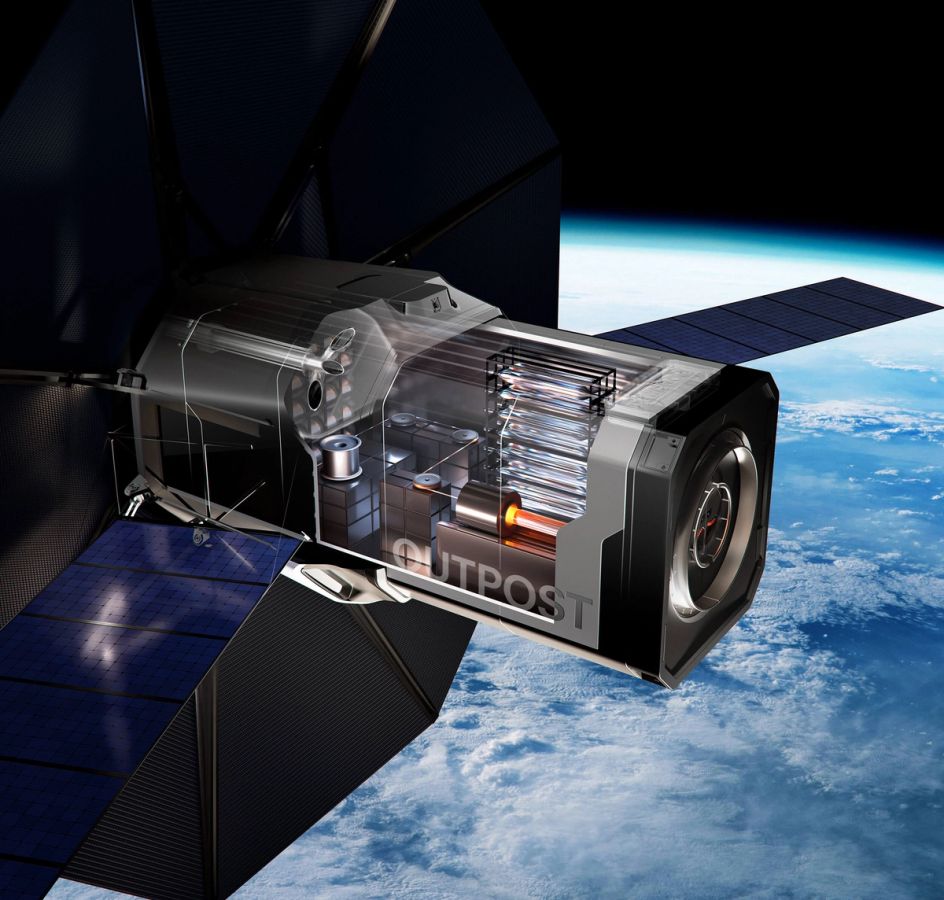
StarFiber is planned as the first product manufactured through Space Factories. Outpost's CarryAll spacecraft, factory container, and process-specific manufacturing modules provide the common infrastructure intended to connect production in orbit with recovered products on Earth.
Learn more about Space Factories: outpost.space/space-factories
About Outpost Technologies Corporation
Outpost is building reusable Earth-return vehicles to move cargo from space to designated locations on Earth with precision, speed and repeatability. Its CarryAll vehicle family is designed to support national security logistics, orbital warehousing and in-space manufacturing. Based in Playa Vista, California, Outpost is building the return infrastructure of the space economy. Learn more at outpost.space.
Media contact
media@outpost.space