Orbital Cargo Firms Aim To Make Space Reentry Routine
by Vivienne Machi
Posted by Aviation Week on Sept. 4, 2026
In a red-brick building in the Playa Vista neighborhood of Los Angeles, a space startup is developing an orbital shipping container that company leaders say could soon deliver up to 10 tons of cargo anywhere on Earth in 60 min.
Less than a mile from where Howard Hughes’ legendary Spruce Goose hangar now hosts part of Google’s local campus, Outpost Space is refining its CarryAll vehicle ahead of a planned inaugural orbital mission in 2028. The company, created by founders and senior executives from Axiom Space and Made In Space, is tapping into growing interest in using orbital vehicles to rapidly deliver equipment around the globe—what the U.S. military calls “point-to-point delivery”—as well as hypersonic testing and commercial activities in low Earth orbit (LEO).
- SpaceX’s Starfall debut is seen as validation for commercial reentry vehicles
- Startup Outpost expects to launch its first orbital CarryAll vehicle in 2028
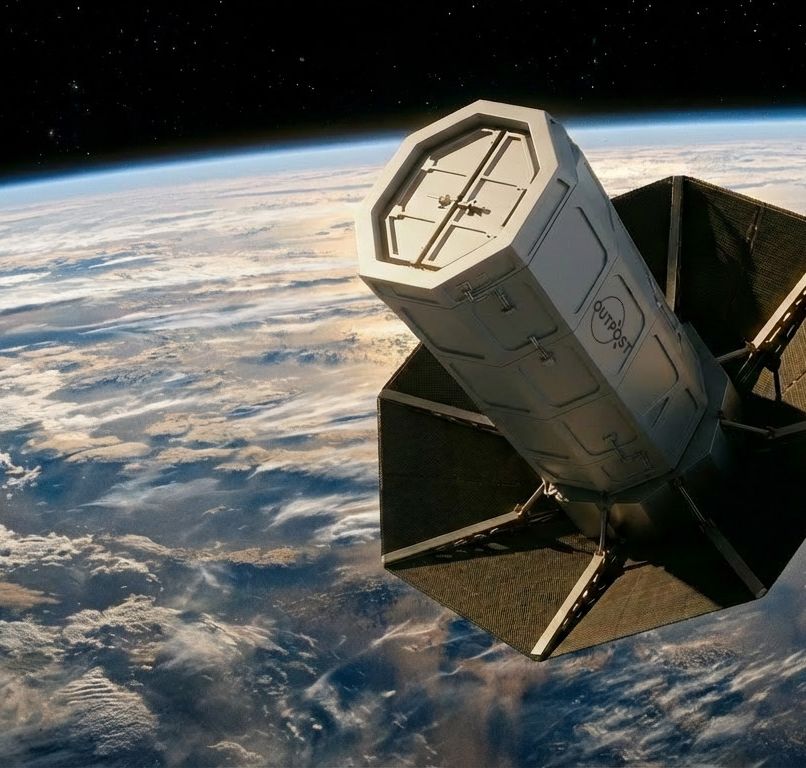
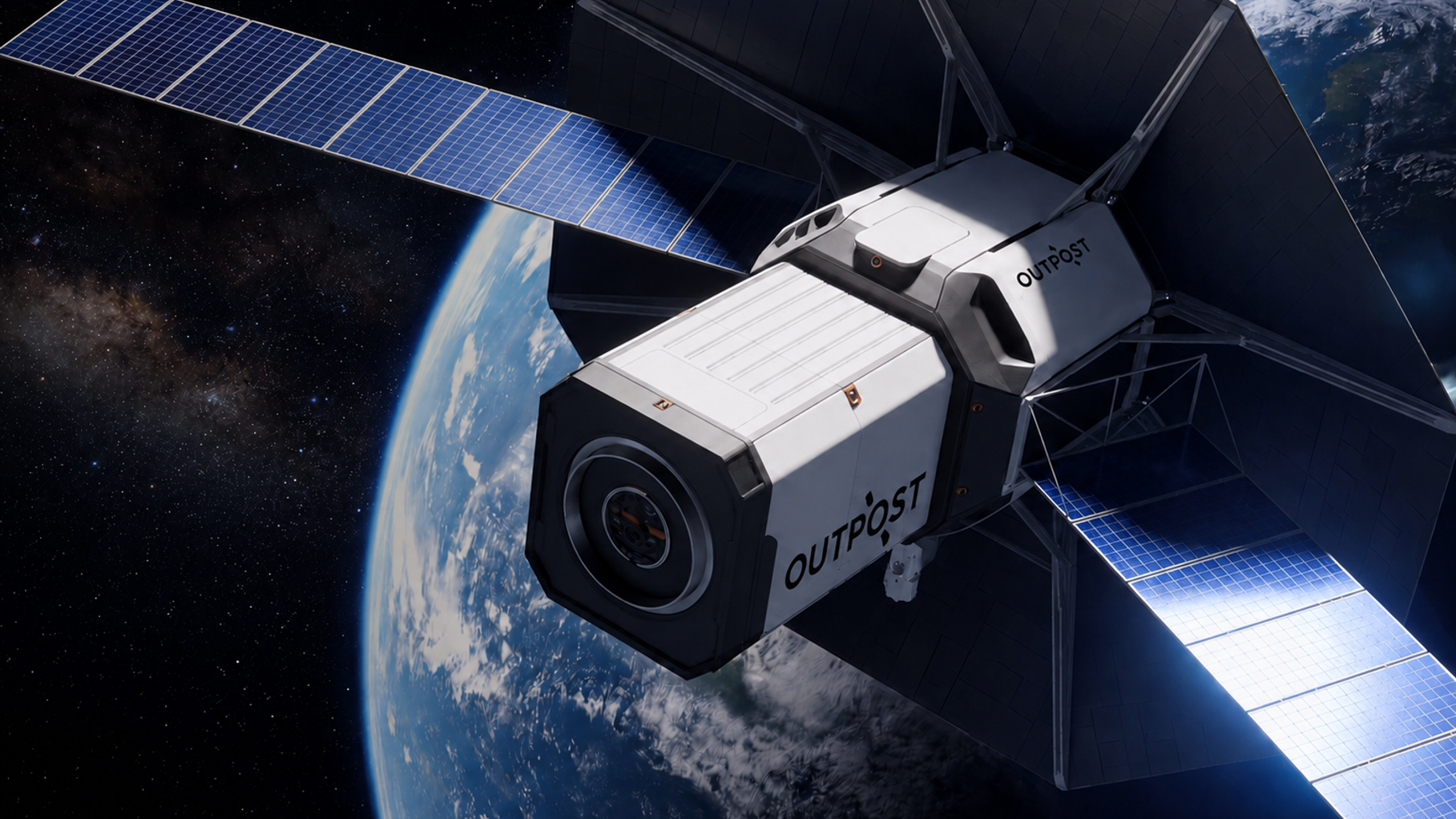
The CarryAll includes a satellite bus, a deployable heat shield, a payload container, a drogue parachute, a paraglider wing and an autonomous robotic guidance system. Long-term, Outpost is developing it as a fully reusable vehicle that can scale to transport between 200 kg (440 lb.) and 10 tons of equipment and launch on medium, heavy or super-heavy launch vehicles. The Air Force Research Laboratory (AFRL), NASA and Space Force innovation arm SpaceWERX have provided support for CarryAll development.
Meanwhile, a smaller vehicle called AirDrop can deliver payloads weighing 50-10,000 lb. from aircraft flying at up to 65,000 ft. using the same multisensor guidance system as the CarryAll for precision landing. Outpost is preparing to move AirDrop into low-rate initial production by year-end, following a series of drop tests.
Before cofounding Outpost, CEO and Chief Technology Officer Jason Dunn launched Made In Space and deployed a 3D printer in 2014 to manufacture parts on the International Space Station for the first time. They then built a second machine that crafted optical fiber on the station. Made In Space was acquired by Redwire in 2020, at which point Dunn left the company and then founded Outpost in 2021.
The toughest part of that journey turned out to be the return flight home, he said in a recent interview at Outpost’s headquarters in Playa Vista. Since the space shuttles were retired in 2011, options to return U.S. payloads from space have been limited to SpaceX Dragon spacecraft. It took six years to return Made In Space’s printer to Earth.
Outpost wants to address that cargo transport problem, Dunn said. He started by using 20-ft. shipping containers as a standard that would fit 10 tons of cargo and exploring ways to use “landing pad precision” to move freight anywhere on the planet with high accuracy. “Then you open the door to this huge opportunity of logistics and manufacturing in space,” he said, noting that reduced launch costs and increased rates also make regular reentry possible.
Orbital reentry vehicle developers see increasing potential as the U.S. military deepens investments in hypersonic testing and studies rapid global delivery through AFRL’s Rocket Cargo program amid a growing market for on-orbit manufacturing. Outpost sees opportunities to increase its contract backlog into the “hundreds of millions” of dollars within 24 months and to pass $1 billion in topline funding by 2030, said President Amir Blachman, a founding executive and former chief business officer at Axiom Space.

SpaceX debuted its Starfall reentry vehicle during a July 23 test flight. Credit: SpaceX
Inversion Space is building its own space-based delivery vehicle—called the Arc and featuring a Kevlar-based parachute drogue—just down the street from Outpost in its own Playa Vista hub. Inversion says Arc will be able to deliver cargo precisely to any point on Earth within 1 hr.
Forty-two miles south in Orange, California, startup Hop Aero is building “rocket cargo vehicles” to deliver equipment to austere environments. The company has its own $1.25 million AFRL contract.
SpaceX is now invested, too. The company launched the first test flight of its Starfall reentry vehicle on June 23 on a Falcon 9 from Space Launch Complex 40 at Cape Canaveral SFS and anticipates launching its first commercial mission in late 2028. The goal, according to a May 15 FAA record of decision approving SpaceX’s Starfall test flights, is to enable point-to-point delivery of “critical cargo through space on rapid timelines” and also to instate a “self-sustaining commercial in-space manufacturing market by offering access to microgravity and vacuum, loiter on orbit and safe return from orbit as a service at scale.”
Meanwhile, Varda Space Systems, headquartered in El Segundo, California, has launched its Winnebago-series space capsule to LEO six times since 2023 and recovered the capsule five times, supporting national security and biopharma customers.
Industry representatives say this diverse range of reentry vehicles could eventually support orbital delivery through space and to territorial destinations from two bookends. On one side is small-cargo delivery across vast distances in minutes, carrying high-value payloads in small form factors reminiscent of a parachute drop. On the other side, tens of tons of cargo could eventually be delivered by SpaceX’s Starship or another super-heavy space vehicle, which would require access to a spaceport and specialized handling—more like the requirements of a Lockheed C-5 Galaxy aircraft.
U.S. Space Force leaders have expressed interest in the concept, albeit down the line. Point-to-point delivery technology must still mature to a level where “the cost is not prohibitive,” Lt. Gen. Gregory Gagnon, commander of the service’s Combat Forces Command, said during a July 17 webinar hosted by the Mitchell Institute for Aerospace Studies.
Gagnon said he expects the Rocket Cargo concept to come to fruition within the next five years. “What you have to realize is you’re going to have to really want that cargo because it’s going to be expensive to get there,” he said. “And if you can wait two days, UPS has got it.”
The Space Force is requesting $19 million in research and development funds for point-to-point delivery in fiscal 2027, then approximately $9.8 million annually through 2031, according to budget documents. The AFRL has transitioned key operational lessons from the Rocket Cargo program into a joint effort known as the Payload Delivery System, led by the Space Force with support from the U.S. Air Force, a spokesperson tells Aviation Week.
“While point-to-point delivery technologies are maturing rapidly, no commercial off-the-shelf solution currently fulfills all operational requirements,” the spokesperson says, adding that the AFRL will explore commercial partnerships and plan demonstration and testing events over the next 1-2 years.
The AFRL has tapped numerous companies to support the Rocket Cargo effort, including Anduril, Blue Origin, Inversion Space, Outpost, Rocket Lab, Sierra Space and SpaceX. The latter secured a $102 million contract to explore the use of Starship for point-to-point logistics missions. Other vendors have won contracts worth $1-2 million to demonstrate such missions with new and existing vehicles. But some of those contracts are growing: In August, the AFRL boosted Blue Origin’s Rocket Cargo contract to just over $13 million from $1.3 million.
Outpost, for its part, has not built its business model purely around the Rocket Cargo program. For Blachman and Dunn, the long-term vision is to become a scaled orbital logistics company that manufactures its own fiber optic material, called StarFiber, in microgravity, and Outpost is building the infrastructure required to support that product. Blachman compared the company’s approach to that of SpaceX or Cargill, logistics companies that manufacture products; SpaceX produces Starlink, and Cargill produces grain and other commodities.
Still, Blachman said the foundation that Outpost built with the U.S. military “from Day 1” has allowed the company to expand quickly. “It’s necessary to get that early customer who’s willing to take a different type of risk,” he said.
The commercial market might come around sooner rather than later. A new National Space Transportation Policy released Aug. 20 advocates for more than 1,000 annual launches and reentries on U.S. soil by 2030.
During The Aerospace Corp.’s Space Policy Forum, held Sept. 2 in Washington, Mandy Vaughn, CEO and founder of space and tech consulting firm GXO, noted a shift away from space companies developing products and opportunities primarily to support life on Earth.
“The value creation will be things happening in space to support other things that are happening just in space,” she said. From cislunar logistics to on-orbit manufacturing and servicing, “that’s a very different market opportunity that we’re just starting to really see come to fruition,” she added.